History
Finds
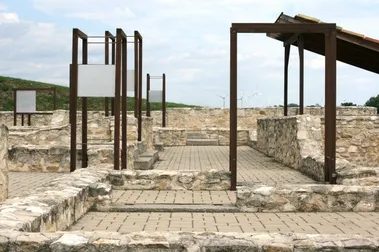
Stray finds of stone axes from the Neolithic period (c. 5000 - 1800 BC), as well as the discovery of a skeletal grave with vessel and bronze grave goods from the early Bronze Age Wieselburg culture (c. 1800 - 1600 BC), show traces of the earliest settlement, as does the excavation of the largest Roman-era building in Burgenland between Bruck-Neudorf and Parndorf, with mosaic floors and bathing facilities; presumed seat of a Boii prince.
1264 to 1715
1264: Parndorf was first mentioned in records on March 25 under "Perun", when King Bela IV granted lands to Leopold of Wieselburg.
1432: On January 24, the Gara family acquired parts of "Perendorff". The name is likely derived from the Old High German "Parindorf" (Middle High German "Pärendorf"). Somewhat later, the Counts of St. Georgen and Bösing came into possession of the village. After their extinction, the village came to be called "Parndorff".
1525: The village was under the rule of Count Leonhard III of Harrach.
1529: The village was destroyed by the Turks.
1570: The village was resettled by Croats from the coastal region of the Croatian Adriatic. During this time, the parish was also re-established, the church was rebuilt and dedicated to St. Ladislaus. The church had already been mentioned in 1430 as the "St. Benedikt Church" (a stone building).
1579: For the first time, a local parish priest named Lukas Masnik is mentioned.
1619 - 1620: Parndorf was afflicted by troops of Bethlen Gabor in a battle with the imperial forces.
1636: On May 18, "Parndorf" finally came back into the possession of the Harrach family through a contract.
1679: The plague ravaged Parndorf.
1683: A letter of protection spared the village from destruction by the Turks.
1703 - 1709: From the time of the Kuruc Wars dates the earthwork still clearly visible today (Lake Neusiedl to Petronell – Schanzenweg).
1713: Parndorf was struck for the last time by cholera and the plague. The residents who were spared erected the Holy Trinity Column and the St. Roch Chapel.
1715: The village had 133 serf farmers, 22 smallholders, a total of 155 families, i.e. approximately 775 residents. Of these, 109 families were Croatian, 38 German, 5 Hungarian and 3 Slovenian.
1716 to 1951
1716 - 1718: The church was enlarged by Count Harrach.
1809: During the Napoleonic Wars, Italian and French divisions passed through Parndorf.
1810: Parndorf was granted market rights.
1837: Parndorf already had a postal station, which was important for the whole surrounding area.
1848: In the year of the revolution, the imperial commander Jellasic put the Hungarian regiments to flight on the "Parndorfer Heide".
1854: The expansion of the railway line from Bruck/Leitha via Parndorf to Raab took place.
1900: Parndorf already counted 2,720 inhabitants, including 1,910 Croats, 421 Germans, 276 Magyars, 68 Slovaks and 45 others. Roman Catholics: 2,648, Protestants: 29 and Mosaic (Jewish): 43.
1918: Towards the end of World War I, the orderly retreat of the army's motorized troops passed through the village over four days. The war claimed 90 dead and 13 missing.
1938 - 1945: The airfield, which had already existed since 1915, was expanded by the purchase of 400 hectares of farmland and developed into a training and operational airport.
1945: In April, Parndorf was a front-line area for four days. Over 200 buildings burned down or were destroyed. 30 civilians were killed. The war also claimed 81 dead and 46 missing.
1951: The war damage of around 5 million Schilling (at the monetary value of the time) had largely been repaired. The village had 2,422 inhabitants, including 1,428 Croats, 951 Germans and 32 Magyars. Roman Catholics: 2,391, Protestants: 27, others: 4.
1957 to 1975
1957: The municipality begins building up its infrastructure. These measures still represent a model for almost all municipalities in the district in these extremely sensitive and highly important areas of municipal activity. In the following years, work on a remarkable infrastructure was pushed forward with great vehemence, for example:
- Construction of the water supply system, the local sewer system including a sewage treatment plant;
- Installation of natural gas, power lines, street lighting, telephone and cable TV connections;
- Asphalting of roads and footpaths;
- Creation of numerous green spaces
Due to the massive expansion of building land, these infrastructural facilities are being continuously expanded and improved.
1969: It the newly built municipal office – which also houses eight apartments – is put into operation. In the same year, a new multi-purpose building is completed. In addition to the fire department and the municipal depot, it also houses a multi-purpose hall.
1971: The new building of the 5-class primary school with a large break hall and gymnasium is opened. The gymnasium is also used – especially in winter – by several clubs as a training venue. Of course, senior citizens' gymnastics also take place there throughout the year.
In this year, the municipality of Parndorf also receives its own coat of arms. According to the official document: "A two-leaved natural thistle on a silver shield". The distinctive plant of the Parndorf Heath can be seen as a symbol of connection to the homeland.
The dedication and opening of the new mortuary hall also took place in 1971. Thanks to the good cooperation between the municipality and the church, the building could be constructed in a very short time.
1975: The new kindergarten is put into operation with two group rooms and one activity room. This had to be expanded by two group rooms in 1991.
1981 to 2011
1981: The census recorded 2,352 residents and houses. The majority of residents are employees, and around 70% of them are commuters, mostly to Vienna.
2001: The census recorded 3,218 residents – 570 more than in 1991: of these, 2,076 were German, 539 Burgenland Croats, 7 Slovenes, 6 Czechs, 113 Hungarians, 23 Serbs, 130 Croats, 204 Turks and 120 others. Roman Catholic: 2,546, Protestant: 102, Orthodox: 50, Muslim: 221, Other: 53, none: 225, unknown: 21.
2005: The renovation and extension of the primary school and the kindergarten on Schulgasse took place, along with the opening of the newly built kindergarten on Emmerich-Kalman-Gasse. A first for the state: the simultaneous inauguration and opening of three public buildings.
2008: The municipal yard (Bauhof) was built and put into operation. In addition, the kindergarten on Emmerich-Kalman-Gasse was extended by two group rooms.
2010: The fire station building was renovated and extended to include the areas of the municipal yard. The expansion of public playgrounds is being pursued.
2011: A general renovation and extension of six classrooms of the primary school took place. Parndorf now has 4,545 residents, of whom 352 have a secondary residence there.
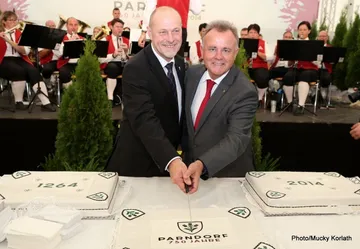
Parndorf celebrates 750 years
In 2014, the municipality of Parndorf celebrated "750 years of Parndorf"!
Extensions and new buildings 2015 to 2017
Renovation of the Municipal Office
Kindergarten III